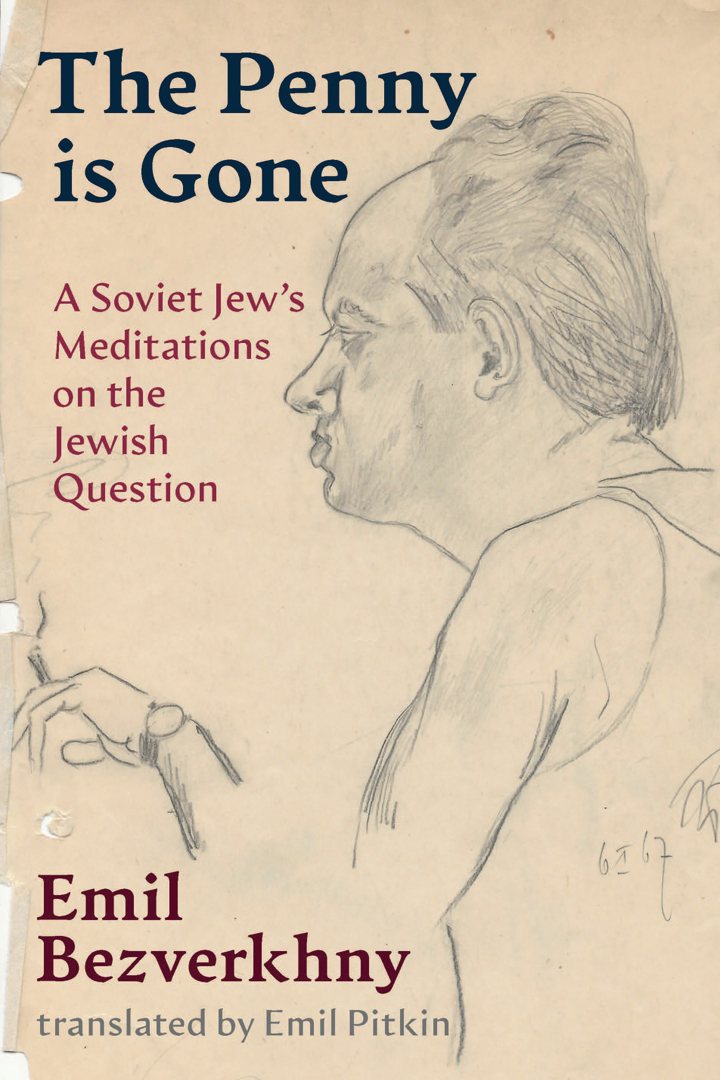
The Penny is Gone
A Soviet Jew’s Meditations on the Jewish Question
Emil Bezverkhny, translated from the Russian by Emil Pitkin
In 1982 a Leningrad physicist, pushed out of the classified institute where he had spent his career, set out to answer one question in secret: why are the Jews leaving the Soviet Union? No Soviet publisher could print the answer. He died two years later, and the typescript waited forty years in his family’s keeping.
His grandson and namesake has translated it.
Why did the Jews leave?
In the 1970s a quarter of a million Soviet Jews, most of them comfortably off, with centuries of roots in the country, gave up everything and left. More than a million would follow. Emil Bezverkhny wanted to know why.
He insisted the book was not a memoir. He called it an attempt to dig out the roots of a tragedy he was living through: a country that had promised equality to everyone was driving away its Jews. Around that question he set his family’s history, childhood hunger in the Siege of Leningrad, his career in Soviet physics, and his search for the reason he was dismissed from a classified institute, through offices and colleagues who would never say the word “Jew.”
The title comes from a parable his father told: a boy who loses a penny is given another, and goes on crying. If he hadn’t lost the first one, he would have had two.
- 1928
Emil Bezverkhny is born in Vynkovtsy, a shtetl in Ukraine. His parents move the family to Leningrad.
- 1941–42
The Siege of Leningrad. Twenty-one members of his family die in the war. His grandparents starve to death; in March 1942 the family escapes across the ice of Lake Ladoga.
- 1946
He enters the country’s leading physics university in Leningrad and goes on to a doctorate measuring ozone on the summit of Mt. Elbrus.
- 1978
He begins writing.
- 1982
He finishes Жаль копеечку. A book like it cannot be published in the Soviet Union.
- 1984
He dies in Leningrad. The typescript stays with his family.
- 2023
After October 7, his grandson decides it can no longer stay private, and translates it.
- 2026
Ben Yehuda Press publishes The Penny is Gone.
From Chapter 4, “Jewish Parables. Father.”
The Penny is Gone
In the summer of 1972, Father’s number two called and started saying goodbye. Duhovny had never called our home before. My confusion made way for understanding when he explained that in a few days he, with his wife and adult daughter, Fruma, would be leaving for Israel. Duhovny, I’d heard from Father, had fought throughout the entire Great Patriotic War65 on the front lines, served in the naval infantry, was a Party member, bore the loss of two sons who’d gone to spend the summer of 1941 in a village near Vinkovtsy in Ukraine and thus met their end at the hands of the Nazis. And now he’s leaving everything behind, leaving forever.
“What’s gotten into you?” I asked. I had to say something.
“I want my dear Fruma to have the same rights in her life as everyone else around her… That’s it.”
“He’s just looking for an excuse.” I then thought, “Doomsaying.”
I didn’t attach much importance to his departure per se (it would, however, play a role in the future when Father received a letter from Israel). It was more that the conversation felt off; it was as if we were speaking past each other in different languages.
A few days later I took my family to Druskininkai in Lithuania, Petras Cvirka Street. Father, who had recently come back from Germany, where he stayed with my sister in Greifswald, was now vacationing on the same street as us. We heard Father’s stories more often than in the past. It seemed that they were inexhaustible.
A barefoot boy, wearing nothing but a long shirt, was walking and bitterly crying.
“What are you crying about, little fellow?” asked a passerby.
“I lost a penny.”
“Let’s cheer you up.” The passerby gives the boy a penny. They walk off, both of them content, each his own way. Suddenly, the boy starts crying again. The passerby turns around and returns to the boy, asking:
“Why are you crying again?”
“I’m sad about my penny. If I hadn’t lost it, I would have had two.”
I’m not a child anymore, but even today I get sad about the lost penny. It’s a familiar refrain: “If only I hadn’t lost it, if only I had saved it…” We’re always wiser in hindsight.
The parable wasn’t composed by an alien from Mars; it is the edged and polished experience of the inhabitants of this earth. Will nobody be sad about us? How many have already been lost: 200,000? 300,000?66 They used to count at least as cogs in the system; now they don’t even count for a penny. How many have to disappear before we understand what we are losing? The loss isn’t a little boy’s but all of Russia’s. “It’s not people but entire worlds that leave…” Evtushenko wrote “perish” where we write “leave,” but the poet will forgive the altered word; in our situation the meaning is practically the same. Naturally, time will pass, the penny will return a hundredfold. But that one is gone forever. It has always been like this.
“The moon is shining,
A kitten cries.”67
- As World War II is still known in Russia. ↩
- These are the 200,000–300,000 Jews who emigrated to Israel and the West in the 1970s. Over a million more would leave in the decade and a half after the manuscript was written. ↩
- The Holy Fool from Pushkin’s Boris Godunov sings this to the old lady who had given him a penny to be remembered to God. She gets nothing in return for it. Some street urchins have stolen the penny. It is gone. ↩
What readers say
“Antisemitism is the politics of the pointing finger. The Penny Is Gone points a finger back and cries ‘j’accuse!’”
“His translation is lucid and gorgeous… at once delectably earthy and beautifully aloof, serving up poetic streaks mixed in with unerring worldly analysis and attention to the finest of detail.”
“The story of Soviet Jewry is one of the great sagas of modern Jewish history. Yet that tale of suffering and resistance is rarely invoked today. Fortunately, we have this beautiful, heartbreaking memoir to remind us of the dignity and heroism that sustained Soviet Jews and inspired Jews around the world.”
“What results is a memoir… which places readers in the restless mind of a man who did everything right, suffered enormously, and was in the end let down by those who promised him utopia.”
In the press
Invite Emil to speak
Emil talks about the book with synagogues, community centers, book groups, universities and podcasts, in person or by video. Conversations usually touch on what the Jews of the Soviet Union endured, the parallels between Soviet and present-day antisemitism, and the life of an extraordinary man.
- Publisher
- Ben Yehuda Press, 2026
- Format
- Paperback, 199 pages
- ISBN
- 978-1-963475-92-0
- Original
- Жаль копеечку, Leningrad, 1982